


1. Introduction and Executive Summary
The evolution of ventilatory support in Intensive Care Units (ICUs) has transitioned from a purely emergency life-support perspective toward a highly personalized medical precision strategy. For decades, the pillars of Protective Mechanical Ventilation (PMV) focused on static and universal limits: maintaining low tidal volumes (Vt) between 6 and 8 mL/kg of ideal body weight and plateau pressures (Pplat) below 30 cmH₂O. However, daily clinical practice persistently demonstrates that a standardized "one-size-fits-all" approach is insufficient given the marked anatomical and pathophysiological heterogeneity of critically ill patients.
In this context of personalization, driving pressure (ΔP) has emerged as one of the most robust and predictive integrating markers of global respiratory mechanics. By unifying the delivered gas volume and the actual elastic capacity of the thoracopulmonary system into a single variable, driving pressure offers a direct window into the actual physical stress to which the functional lung parenchyma is subjected.
A recent review article published in the Acta Colombiana de Cuidado Intensivo (2025), titled "Driving pressure como parámetro integrador en ventilación mecánica: de la fisiología al reto clínico de la personalización" ("Driving pressure as an integrating parameter in mechanical ventilation: from physiology to the clinical challenge of personalization"), rigorously systematizes the physiological foundations of this parameter, analyzes its prognostic impact, and defines its clinical boundaries against highly complex conditions such as obesity, spontaneous effort, and ventilation in patients without Acute Respiratory Distress Syndrome (ARDS).
For healthcare professionals, this advancement demands advanced monitoring tools capable of calculating and displaying dynamic mechanical variables in real time. For healthcare administrators, implementing technologies that facilitate physiology-driven ventilation represents a strategic opportunity to mitigate Ventilator-Associated Lung Injury (VALI), reduce ICU length of stay, and optimize the operational cost-effectiveness of the critical care unit. As global leaders in life-support technology, at Chenwei Medical we align our advanced engineering with this scientific evidence, equipping our intensive care platforms with cutting-edge capabilities destined for the personalization of ventilatory
therapeutics.
2. Physiological Foundations of Driving Pressure (ΔP) and the Baby Lung Concept
From an operational standpoint, driving pressure (ΔP) is formally calculated through the difference between the plateau pressure (Pplat) measured during a prolonged inspiratory pause and the total positive end-expiratory pressure (PEEPt), which contemplates both the programmed PEEP level on the equipment and the presence of auto-PEEP or intrinsic PEEP. Mathematically, this relationship is expressed as follows:
ΔP = Pplat – PEEP(total)
Alternatively, and complementarily, respiratory physiology allows redefining ΔP as the direct ratio between the administered tidal volume (Vt) and the static compliance of the respiratory system (Crs):
ΔP = Vt/Crs
This alternative formulation is crucial for clinical practice, as it demonstrates that ΔP is not a simple static pressure value in the airway, but rather the reflection of the dynamic interaction between the volume ejected by the ventilator and the intrinsic elastance of the patient's system. A respiratory system with an elevated respiratory system elastance (Ers), meaning a rigid lung and/or chest wall will require significantly higher-pressure gradients to displace the same net volume of gas.

This interaction takes on a profound biological meaning when analyzed through the prism of the baby lung concept, originally introduced by Gattinoni and colleagues. In acute inflammatory pathologies such as ARDS, the volume of lung parenchyma that remains adequately aerated and functional is drastically reduced and heterogeneously distributed.
Consequently, a tidal volume of 400 mL, which under normal anatomical conditions would be completely harmless, generates critical levels of regional tissue deformation (strain) and effective transpulmonary pressure (stress) when introduced into a severely diminished remanent alveolar space. Therefore, ΔP acts in the clinical setting as an indirect but faithful surrogate for the functional size of the available lung, alerting the clinician when the programmed ventilatory load exceeds the elastic tolerance of the remaining alveolar units.
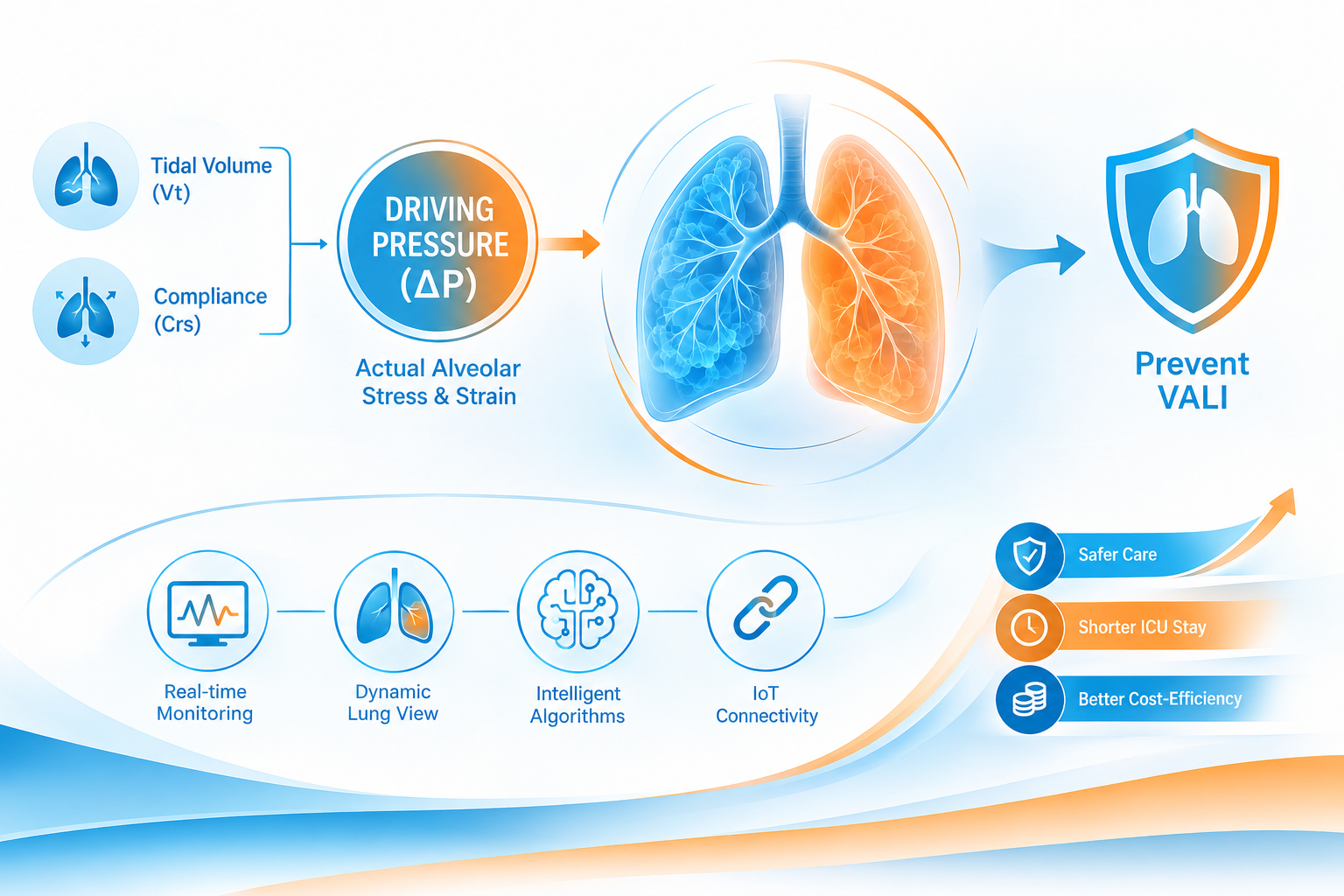
3. The Prognostic Power of Driving Pressure (ΔP) and Its Clinical Superiority Over Traditional Methods
The massive interest of the international intensive care community in the continuous monitoring of Driving Pressure (ΔP) was consolidated following the landmark study by Amato et al. (2015), an analysis involving more than 3,500 patients with ARDS. This study demonstrated that (ΔP) is the most potent independent predictor of in-hospital mortality among the mechanical variables of the ventilator, statistically outperforming tidal volume and PEEP analyzed in isolation.
The evidence analyzed in the review by Pena-López et al. (2025) emphasizes that isolated increases in Vt or decreases in PEEP levels increase mortality only if such adjustments lead to a parallel increase in ΔP. Conversely, titration strategies that successfully decrease net ΔP levels are reproducibly associated with higher survival rates in critically ill patients.Large-scale investigations conducted by authors such as Guérin et al. confirmed that an elevated ΔP stands as an independent risk factor for fatal outcomes, even when the
patient is strictly ventilated under traditional lung-protective protocols that limit Pplat to below 30 cmH₂O.
International medical literature suggests establishing a dynamic safety limit for ΔPsituated between 14 and15 cmH₂O. Exceeding this critical threshold exponentially increases the risk of cyclic mechanical overdistension and perpetuates the phenomena of biotrauma and VALI. The clinical benefit of individualizing tidal volume based on ΔP and actual Crs, rather than using a static calculation based solely on ideal body weight, is indisputable for optimizing the safety of the functional parenchyma.
4. Clinical Frontiers and Challenges in the Interpretation of ΔP
Despite its extraordinary clinical value, the exhaustive review highlights that Driving Pressure measured exclusively in the proximal airway presents severe pathophysiological limitations in daily ICU scenarios:
A. The Phenomenon of Spontaneous Respiratory Effort
During assisted or supported ventilatory modes (where the patient retains partial control of their respiratory musculature), the pressure measured by the ventilator's transducer stops faithfully reflecting actual lung stress. When the diaphragm actively contracts, it generates a sharp drop in esophageal pressure (Pes), which notably increases the elastic transpulmonary pressure (PL) without this change manifesting proportionally in the airway pressure (Paw). This dissociation phenomenon can cause a dangerous underestimation of effective tissue stress, inducing the clinician into a false sense of ventilatory safety.
B. The Impact of Obesity and a Rigid Chest Wall
Since the respiratory system is composed of two structures arranged in series the lung parenchyma and the chest wall the obtained ΔP encompasses the energy required to distend both compartments. In patients with morbid obesity, intra-abdominal hypertension, or chest wall deformities (such as kyphoscoliosis), chest wall elastance (Ecw) is drastically increased.
In these individuals, a substantial fraction of the ΔP measured in the airway is dissipated exclusively to displace extrapulmonary structures and the adipose mass of the chest wall, rather than to distend the alveoli. This gives rise to the so-called "obesity paradigm", where elevated ΔP values do not correlate with higher mortality or actual alveolar overdistension.
C. Applicability Outside the Context of ARDS
In patients undergoing mechanical ventilation for extrapulmonary causes or in the perioperative setting of major surgeries (abdominal or thoracic), the association between ΔP and in-hospital mortality tends to display flatter risk curves and greater methodological heterogeneity than in frank respiratory distress. Nevertheless, monitoring the parameter remains highly useful as a continuous tool for preventive physiological surveillance to avoid postoperative respiratory complications.
5. Cutting-Edge Technological Solutions by Chenwei Medical: Transforming Data into Precise Clinical Decisions
To satisfactorily respond to the complex clinical challenges described in the review by Pena-López et al. (2025), healthcare personnel require ventilation systems that transcend basic volumetric support and integrate advanced mechanical signal processing algorithms. At Chenwei Medical, we have designed our families of intensive care ventilators under the cardinal premise of facilitating physiological monitoring of the highest precision.
Advanced Integrated Monitoring in the Chenwei ICU Ventilator Series
Our advanced intensive care platforms, such as the award-winning Chenwei ICU Ventilator T80 (equipped with a 15.6-inch high-definition touchscreen) and the Model T60, offer key tools to optimize driving pressure monitoring:
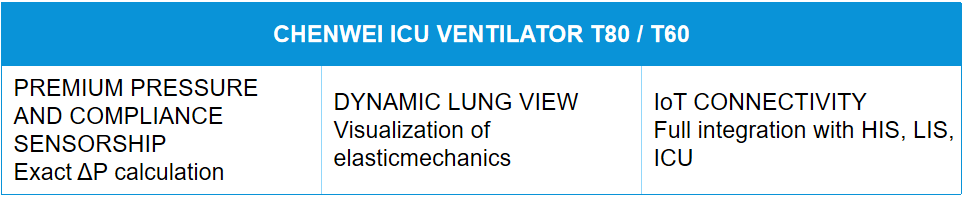
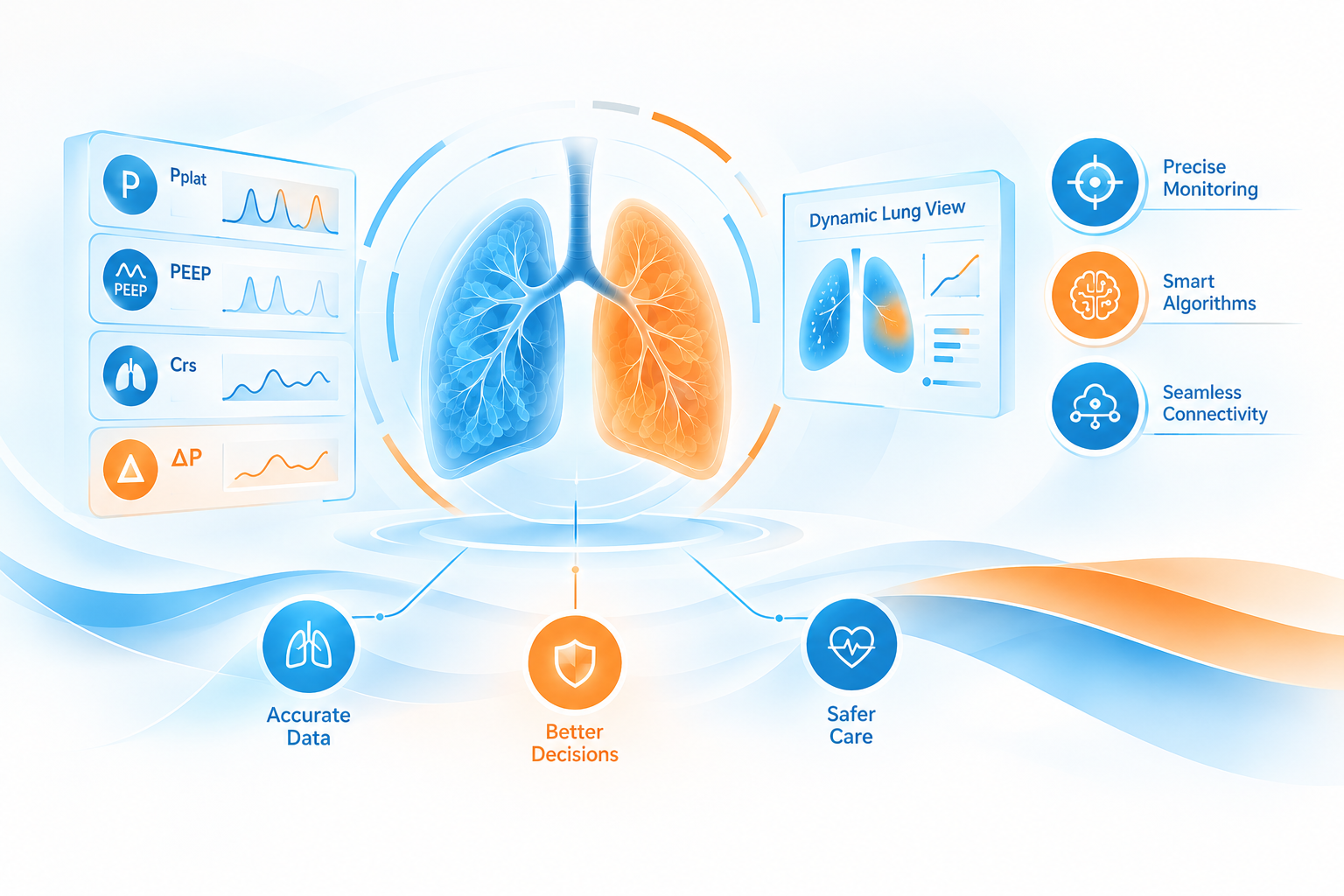
1. Continuous and Reliable Calculation of Critical Variables: Premium imported flow and pressure sensors integrated into Chenwei equipment allow recording plateau pressure (Pplat), total PEEP, and static compliance (Crs) with millimetric precision, facilitating the direct and instantaneous display of ΔP on the screen.
2. Dynamic Lung View: This state-of-the-art software tool simulates and illustrates graphically and in real time the morphological variations in the patient's lung compliance and airway resistance. It allows intensivists to intuitively observe if the lung is operating in a zone of high rigidity, facilitating timely decision-making to
mitigate the risk of VALI.
3. Intelligent Compliance Compensation Algorithms: Chenwei ventilators incorporate advanced systems for the automatic compensation of tidal volume based on circuit and parenchymal compliance, guaranteeing that the programmed volume is effectively delivered to the baby lung.
4. Alveolar Recruitment Tools (Recruitment Maneuver): Natively integrated into the T80 Series, these automated functions allow evaluating the patient's alveolar recruitment potential in a safe and controlled manner, enabling the clinician to establish the optimal PEEP that minimizes the resulting ΔP.
Facing the challenge of assisted ventilation with spontaneous effort, Chenwei ventilators feature advanced modes such as Pressure Regulated Volume Control (PRVC) and Airway Pressure Release Ventilation (APRV), along with ultra-sensitive flow triggers. These modalities facilitate excellent patient-ventilator synchrony, reducing severe asynchronies that distort elastic pressure measurements and protecting lung tissue against induced muscular and alveolar damage.
6. Administrative Perspective: Cost-Effectiveness, Risk Management, and Return on Investment
For medical directorates and healthcare system administrators, choosing technological equipment for critical areas cannot be based solely on commercial variables; it must be firmly grounded in the concept of evidence-based medicine and the operational efficiency of the institution.
Ventilator-Associated Lung Injury (VALI) and poorly managed respiratory distress carry severe economic consequences for hospitals, exponentially increasing the days of invasive mechanical ventilation, the rate of healthcare-associated infections (such as ventilator-associated pneumonia), and costs due to extrapulmonary complications.
The incorporation of intelligent ventilators from Chenwei Medical positively impacts institutional resource management through three fundamental pillars:
Reduction of Complications and Hospital Stay: By providing advanced monitoring tools like dynamic ΔP calculation and Dynamic Lung View, our equipment reduces human error in ventilatory programming. Personalized ventilation decreases weaning time and the average stay in the ICU, freeing up critical beds at a faster rate.
Intelligent Data Interconnection Platform (IoT): Chenwei's life-support solutions integrate natively with Hospital Information Systems (HIS), Laboratory Information Systems (LIS), and PACS through advanced network interfaces (Ethernet, USB, digital data outputs). This centralizes respiratory mechanics metrics onto clinical dashboards, allowing medical directors to audit the quality of care and ensure compliance with institutional safe ventilation goals.
High Durability and Low Total Cost of Ownership: Equipped with high-durability turbines with a certified lifespan of up to 40,000 hours, Chenwei devices guarantee continuous operability with minimized preventive maintenance requirements, significantly optimizing the return on investment for hospital administration.
7. Conclusions and Institutional Clinical Message
Driving Pressure (ΔP) has ceased to be a physiological variable of purely academic interest to consolidate itself as the gold standard in monitoring Protective Mechanical Ventilation at the bedside of the critically ill patient. By integrating the delivered tidal volume and the residual elastic compliance into a single indicator, ΔP provides clinicians with the necessary information to protect the baby lung against the destructive stress of artificial ventilation.
However, as contemporary scientific literature indicates, this parameter must not be interpreted in isolation; it requires a contextualized view that considers the presence of spontaneous effort, obesity, and the thoracoabdominal dynamics of each individual.
At Chenwei Medical, under our institutional philosophy "Care for Every Vital Moment", we assume a steadfast commitment to providing the international medical community with intelligent technological tools that convert these complex physiological concepts into automated, safe, and highly precise therapeutic actions. By investing in advanced mechanical ventilation technologies, healthcare institutions not only raise the safety and survival standards of their most vulnerable patients but also ensure efficient, standardized, and highly cost-effective clinical management.
Key Bibliographic References
Pena-López LA, Garay-Fernández M, Chica-Meza C, et al. Driving pressure como parámetro integrador en ventilación mecánica: de la fisiología al reto clínico de la personalización. Acta Colombiana de Cuidado Intensivo. 2025;25(1):681-692.
Amato MBP, Meade MO, Slutsky AS, et al. Driving Pressure and Survival in the acute respiratory distress syndrome. N Engl J Med. 2015; 372:747-755.
Gattinoni L, Pesenti A, Bombino M, et al. Relationships Between Lung Computed Tomographic Density, Gas Exchange, and PEEP in Acute Respiratory Failure. Anesthesiology. 1988; 69:824-832.
Akoumianaki E, Maggiore SM, Valenza F, et al. The Application of Esophageal Pressure Measurement in Patients with Respiratory Failure. Am J Respir Crit Care Med. 2014; 189:520-531.
Chenwei Medical Technology Documentation. ICU Ventilation Solutions and Interconnection Platforms (T80, T60, Smart Critical Care Systems). Chenwei Corporate Portfolio, 2025-2026.
Disclaimer
This article is intended for healthcare professionals for educational and informational purposes only. It does not substitute for professional clinical judgment, diagnosis, or treatment. Ventilator settings and adjustments should be performed only by qualified medical personnel based on individual patient assessment, applicable clinical protocols, and the operating instructions for the specific ventilator.
The information presented here is not intended to constitute medical advice, treatment recommendations, or a guarantee of the clinical efficacy or safety of any product. Product functions, specifications, and performance characteristics may vary by model and configuration and should be verified against the applicable product documentation.