


Mechanical Ventilation in High-Temperature Environments: Technical Considerations and T80 Application Guide

Abstract
High-temperature environments can present additional challenges for critical care delivery, particularly in regions where elevated ambient temperatures coincide with limited access to fully climate-controlled intensive care facilities. At the same time, critically ill patients may experience fever or hyperthermia associated with severe infection, sepsis, heatstroke, or other systemic conditions.
Mechanical ventilation in these settings requires attention to both patient-related physiological changes and equipment-related factors, including gas conditioning, respiratory system resistance, unintentional leakage, humidification, and the stability of ventilation performance.
This article reviews key considerations for mechanical ventilation in high-temperature environments and summarizes practical approaches to invasive ventilation, non-invasive ventilation (NIV), and high-flow oxygen therapy. It also discusses how the Chenwei T80 ICU Ventilator integrates high-flow turbine technology, dynamic compensation functions, comprehensive ventilation modes, and respiratory monitoring capabilities to support respiratory care across demanding clinical environments.
Note: The recommendations in this article are general technical and clinical considerations and should not replace the clinical judgment of qualified healthcare professionals, local clinical protocols, or the T80 User Manual.
1. Why High-Temperature Environments Matter in Critical Care
High ambient temperature can affect both patients and respiratory equipment.
For critically ill patients, fever and hyperthermia may increase metabolic demand and respiratory workload. In mechanically ventilated patients, higher body temperature has also been associated with adverse clinical outcomes in specific patient populations. For example, an observational study of mechanically ventilated COVID-19 patients found that higher peak ICU temperatures were associated with increased mortality risk. However, these findings should be interpreted within the specific population and study design rather than generalized to all mechanically ventilated patients. [1]
Fever has also been associated with longer mechanical ventilation duration. In a multicenter observational analysis, a maximum body temperature ≥37.5°C was associated with a longer mean ventilation time among medically admitted survivors. [2]
These findings highlight an important clinical principle:
Temperature management and respiratory support should be considered together, while ventilation settings remain individualized according to the patient's respiratory mechanics, gas exchange, hemodynamic status, and underlying disease.
At the equipment level, high ambient temperature may also influence respiratory gas conditioning, measurement conditions, and the thermal load placed on ventilator components. Appropriate equipment specifications, environmental control, maintenance, and monitoring are therefore important when ventilators are deployed in hot climates.
2. Key Technical and Clinical Considerations
2.1 Patient Fever and Hyperthermia
Fever and hyperthermia can increase metabolic oxygen demand and carbon dioxide production. Depending on the underlying condition, critically ill patients may also present with increased respiratory drive, airway secretions, impaired lung compliance, or increased respiratory system resistance.
These factors may increase the work of breathing and influence patient-ventilator interaction.
Clinical management should therefore focus on:
Identifying and treating the underlying cause of fever or hyperthermia.
Monitoring oxygenation and ventilation.
Assessing respiratory drive and patient-ventilator synchrony.
Monitoring airway pressure, tidal volume, minute ventilation, and respiratory mechanics.
Applying lung-protective ventilation principles when invasive mechanical ventilation is required.
Reassessing ventilation settings as the patient's physiological condition changes.
Importantly, elevated body temperature should not by itself trigger a predetermined change in PEEP, inspiratory flow, or tidal volume. Such parameters should remain patient-specific and be adjusted according to established clinical protocols.
2.2 Temperature and Respiratory Gas Measurement
Respiratory gas temperature, pressure, and humidity can influence gas measurement conditions. In respiratory care equipment, appropriate compensation and calibration are therefore important for maintaining accurate monitoring and control.
The relationship between gas temperature and volume follows basic thermodynamic principles, but clinical ventilator measurements are more complex than a simple application of Charles's Law. Measurement accuracy can also depend on pressure, humidity, gas composition, sensor characteristics, and the reference conditions used by the device.
For this reason, ventilators deployed in challenging environments should incorporate appropriate measurement and compensation mechanisms and should be operated within their specified environmental conditions.
2.3 Unintentional Leakage During NIV
Leakage is a common challenge during non-invasive ventilation. Excessive or unstable leakage can affect:
Delivered pressure
Triggering and cycling
Patient-ventilator synchrony
Delivered ventilation
Alarm performance
Humidification
In high-temperature environments, clinical teams should pay particular attention to mask fit, patient positioning, circuit configuration, and the condition of interfaces and accessories.
Rather than relying solely on maximum turbine flow, effective NIV performance depends on the ventilator's overall control system and its ability to compensate for leakage under the applicable operating conditions.
The Chenwei T80 incorporates dynamic leak compensation for NIV and provides real-time monitoring of respiratory parameters and leakage-related information, supporting clinicians in identifying and managing changing ventilation conditions.
3. Humidification in Hot-Climate Ventilation
Adequate humidification is essential during invasive mechanical ventilation because bypassing the upper airway reduces the natural warming and humidification of inspired gas.
Insufficient humidification may contribute to:
Thickened respiratory secretions
Airway obstruction
Endotracheal tube occlusion
Impaired mucociliary function
Patient discomfort
A bench study evaluating heated humidifiers demonstrated that increased airflow and unintentional leakage can reduce humidification effectiveness under certain ventilation configurations. [3]
Respiratory gas conditioning may also influence heat exchange in febrile patients. A small pilot study suggested that HME-based respiratory gas conditioning could reduce respiratory heat loss and potentially prolong hyperthermia in selected mechanically ventilated patients. Because the study involved a small patient population, its findings should be interpreted cautiously and should not be generalized to all patients. [4]
Practical considerations
For patients requiring invasive ventilation:
Select humidification according to the patient's clinical condition and local protocol.
Monitor secretion characteristics and airway patency.
Check the humidifier, chamber, circuit, and temperature settings regularly.
Consider the impact of high leakage and high gas flow on humidification performance.
Avoid excessive condensation and maintain appropriate circuit management.
The appropriate humidification strategy should always follow the humidifier manufacturer's instructions and the patient's clinical requirements.
4. Ventilation Strategies in High-Temperature Clinical Settings
High ambient temperature does not require a separate ventilation strategy by itself. Instead, clinicians should apply established lung-protective and patient-specific ventilation principles while accounting for environmental and equipment-related factors.
4.1 Invasive Mechanical Ventilation
For patients with ARDS or other conditions requiring invasive ventilation, lung-protective ventilation remains a central principle.
Common considerations include:
Tidal Volume
For patients with ARDS, low tidal-volume ventilation based on predicted body weight is generally recommended. A commonly used starting range is approximately:
4–6 mL/kg predicted body weight (PBW) with subsequent adjustment according to clinical response and established ARDS protocols.
Plateau Pressure
Where appropriate, plateau pressure should be monitored, with commonly accepted lung-protective strategies targeting:
Pplat ≤30 cmH₂O
Driving Pressure
Driving pressure may be monitored as an additional indicator of respiratory system stress. In patients with ARDS, lower driving pressure has been associated with better outcomes, although the appropriate target should be interpreted in the context of the individual patient's respiratory mechanics.
PEEP
PEEP should be individualized according to oxygenation, respiratory mechanics, recruitability, hemodynamic status, and the underlying disease.
High ambient temperature alone should not be used as an indication for automatically increasing PEEP.
Monitoring
Where available, clinicians may monitor:
P0.1
RSBI
Static and dynamic compliance
Airway resistance
Work of breathing
Intrinsic PEEP
Peak and plateau pressure
Tidal volume and minute ventilation
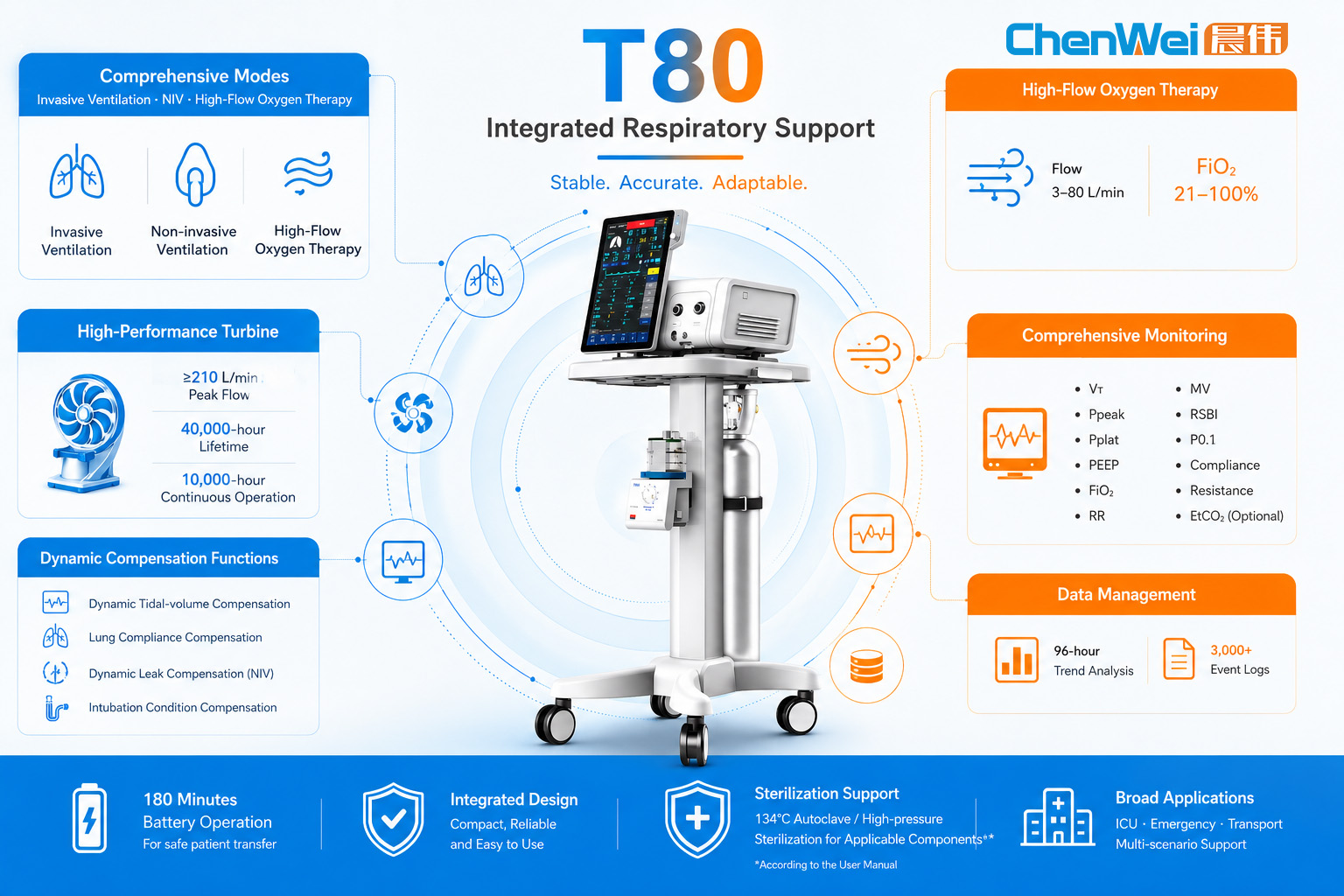
The T80 provides monitoring of parameters including P0.1, RSBI, resistance, compliance, WOB, PEEP, Ppeak, Pplat, tidal volume, minute ventilation, and other respiratory parameters.
5. NIV in High-Temperature Environments
NIV can be particularly sensitive to unintentional leakage and patient-ventilator synchrony.
A practical NIV approach should include:
Interface Management
Select an appropriate mask/interface.
Check mask positioning and fit.
Minimize excessive unintentional leakage without causing excessive facial pressure.
Reassess the interface when the patient's position or condition changes.
Ventilator Settings
EPAP, inspiratory pressure, pressure support, trigger sensitivity, cycling criteria, and backup settings should be individualized according to the patient's respiratory condition and the selected NIV mode.
Monitoring
Clinicians should continuously assess:
SpO₂
Respiratory rate
Work of breathing
Patient comfort
Tidal volume
Minute ventilation
Leakage
Triggering and cycling
Blood gas results where clinically indicated
The T80 provides multiple NIV modes together with dynamic leak compensation and comprehensive monitoring functions, supporting ventilation stability when leakage conditions change.
6. High-Flow Oxygen Therapy
High-flow oxygen therapy can provide respiratory support for selected patients with hypoxemic respiratory failure and may be used as part of a sequential respiratory support strategy.
Clinical application should consider:
Severity of hypoxemia
Respiratory distress
Work of breathing
Oxygen requirements
Hemodynamic status
Risk of delayed escalation
Availability of close monitoring and timely intubation
The T80 incorporates high-flow oxygen therapy with an adjustable oxygen concentration of 21–100% and a maximum gas flow of 80 L/min.
These capabilities allow the same platform to support different stages of respiratory care, from high-flow oxygen therapy to NIV and invasive mechanical ventilation, according to clinical requirements.

7. Chenwei T80: Technical Capabilities for Demanding Clinical Environments
The Chenwei T80 ICU Ventilator is designed as a multi-scenario respiratory support platform combining invasive ventilation, NIV, and high-flow oxygen therapy. Its technical configuration provides several features relevant to challenging ICU environments.
7.1 High-Performance Turbine
The T80 uses a high-performance turbine system with a maximum peak flow of:
≥210 L/min
The turbine is specified with a 40,000-hour lifetime and supports continuous operation for up to 10,000 hours. This high-flow architecture provides substantial flow capacity for demanding ventilation applications, including NIV and high-flow respiratory support.
The availability of high flow capacity should not, however, be interpreted as equivalent to a specific guaranteed leakage-compensation volume under every clinical condition. Actual performance depends on operating mode, pressure, circuit configuration, interface, and other factors.
7.2 Dynamic Compensation Functions
The T80 incorporates automatic compensation functions supporting ventilation accuracy and stability.
Its official product information describes:
Dynamic tidal-volume compensation
Lung compliance compensation
Dynamic leak compensation for NIV
Compensation related to intubation conditions
These functions are designed to help maintain appropriate ventilation performance as respiratory system conditions change.
Rather than describing these functions as a single "four-dimensional algorithm," this guide uses the more clinically transparent term" dynamic compensation functions".
7.3 Comprehensive Respiratory Support
The T80 integrates:
Invasive ventilation
Non-invasive ventilation
High-flow oxygen therapy
Its ventilation modes include VCV, PCV, PSV, SIMV, A/C, PRVC, CPAP, BIPAP, APRV, HFNC/O₂ Remedy, and other modes depending on configuration.
This sequential respiratory support capability can be valuable in clinical workflows where patients transition between different levels of respiratory support.
7.4 High-Flow Oxygen Capability
The integrated high-flow oxygen function provides:
Flow: 3–80 L/min
FiO₂: 21–100%
The T80 uses an electronic air-oxygen mixing system to provide adjustable oxygen concentration across this range.
7.5 Respiratory Monitoring and Data Management
The T80 provides monitoring of a broad range of respiratory parameters, including:
Tidal volume
Minute ventilation
Respiratory rate
Ppeak
Pplat
PEEP
FiO₂
Leakage
RSBI
P0.1
Airway resistance
Compliance
WOB
EtCO₂, when the optional module is installed
The system also provides 96-hour trend analysis and storage for at least 3,000 logs and alarm records, with data export functionality.
These capabilities can support clinical review, trend assessment, equipment management, and documentation.
7.6 Patient Transfer and Power Backup
The T80 incorporates an internal lithium battery providing up to:
180 minutes of battery operation
This supports patient transfer and intra-hospital mobility when mains power is temporarily unavailable, subject to operating conditions and battery status.
7.7 Cleaning and Sterilization Support
The T80 is designed with an integrated inspiratory and expiratory valve assembly and supports 134°C autoclave/high-pressure sterilization for applicable components, according to the manufacturer's specifications.
Users should always follow the T80 User Manual and applicable instructions for use regarding which components can be sterilized and the validated sterilization procedure.
8. Practical Checklist for Ventilator Deployment in Hot Climates
Hospitals and healthcare providers planning to deploy ventilators in high-temperature regions should consider the following areas.
Environmental Conditions
Confirm the ventilator's specified operating temperature and humidity range.
Maintain adequate room ventilation and climate control where available.
Avoid direct exposure to sunlight or external heat sources.
Ensure sufficient clearance around the ventilator for heat dissipation.
Gas Supply
Verify oxygen source pressure and stability.
Confirm compatibility between the ventilator and available oxygen infrastructure.
Where applicable, prepare alternative oxygen sources for transport or emergency use.
Humidification
Verify humidifier operation before use.
Monitor water level and temperature.
Check circuit condensation.
Assess secretion characteristics regularly.
Pay particular attention to humidification when high flow or significant leakage is present.
NIV
Check mask/interface fit.
Monitor unintentional leakage.
Assess patient-ventilator synchrony.
Reassess trigger and cycling settings when leakage changes.
Establish clear criteria for escalation to invasive ventilation.
Invasive Ventilation
Apply lung-protective ventilation principles.
Monitor airway pressure and respiratory mechanics.
Evaluate tidal volume according to predicted body weight.
Reassess PEEP and FiO₂ according to oxygenation and patient response.
Monitor for secretion retention and airway obstruction.
Equipment Maintenance
Follow the manufacturer's preventive maintenance schedule.
Inspect breathing circuits, filters, valves, sensors, and accessories.
Check alarms and battery status.
Ensure appropriate cleaning and sterilization procedures.
Maintain adequate spare parts and consumables for local operating conditions.
9. What High-Temperature Regions Should Look for When Selecting an ICU Ventilator
For hospitals and healthcare systems operating in hot climates, ventilator selection should extend beyond peak flow alone.
Key evaluation criteria include:
1. Stable respiratory performance
The ventilator should provide reliable ventilation control and monitoring within its specified environmental operating range.
2. Adequate flow capacity
High flow capacity can be particularly valuable for NIV and high-flow oxygen applications, although actual performance should always be evaluated under defined operating conditions.
3. Effective leakage compensation
NIV performance depends heavily on the ventilator's ability to manage unintentional leakage and maintain patient-ventilator synchrony.
4. Accurate monitoring and compensation
Dynamic compensation and comprehensive respiratory monitoring can help clinicians identify changes in tidal volume, compliance, resistance, leakage, and patient effort.
5. Multiple respiratory support modalities
A platform supporting invasive ventilation, NIV, and high-flow oxygen therapy can simplify respiratory care across different stages of patient management.
6. Data management
Trend analysis and event logging can support clinical review, quality management, maintenance, and documentation.
7. Transport capability
Battery backup and compact design can facilitate patient transfer within hospitals and emergency departments.
10. Conclusion
High-temperature environments introduce additional operational and clinical challenges for critical care teams. The combination of elevated ambient temperature, patient fever or hyperthermia, high respiratory demand, unintentional leakage, and humidification requirements makes reliable respiratory support particularly important in resource-variable and climate-challenged healthcare environments.
However, high ambient temperature should not be treated as an independent indication for fixed ventilator settings. Clinical decisions should remain individualized and should follow established lung-protective ventilation principles, local protocols, manufacturer instructions, and the patient's physiological response.
For equipment selection, hospitals should consider not only peak flow but also ventilation stability, leakage compensation, respiratory monitoring, humidification management, power backup, data recording, and the ability to provide multiple forms of respiratory support.
With a ≥210 L/min peak-flow turbine, 40,000-hour turbine lifetime, dynamic compensation functions, invasive and non-invasive ventilation, high-flow oxygen therapy up to 80 L/min, comprehensive respiratory monitoring, 96-hour trend analysis, 3,000+ event logs, and up to 180 minutes of battery operation, the Chenwei T80 provides an integrated respiratory support platform for ICU, emergency, and patient-transfer applications.
In challenging clinical environments, the goal is not simply to deliver more ventilation, but to provide stable, measurable, adaptable respiratory support that helps clinicians respond to changing patient conditions.
Chenwei Medical — Care For Every Vital Moment.
References
Choron RL, Butts CA, Bargoud C, et al. Fever in the ICU: A Predictor of Mortality in Mechanically Ventilated COVID-19 Patients. Journal of Intensive Care Medicine. 2021;36(7):800–807. doi:10.1177/0885066620979622.
Park DW, Egi M, Nishimura M, et al. The Association of Fever with Total Mechanical Ventilation Time in Critically Ill Patients. Journal of Korean Medical Science. 2016;31(12):2033–2041. doi:10.3346/jkms.2016.31.12.2033.
Haziot N, Ibrahim M, Zhu K, et al. Impact of leaks and ventilation parameters on the efficacy of humidifiers during home ventilation for tracheostomized patients: a bench study. BMC Pulmonary Medicine. 2019;19:43. doi:10.1186/s12890-019-0812-z.
Urakov A, Shchegolev A, Kasatkin A. Respiratory gas conditioning with filters/heat and moisture exchangers can increase the duration of hyperthermia in patients under mechanical ventilation. Medical Gas Research. 2020;10(1):60–62. doi:10.4103/2045-9912.279986.
Serpa Neto A, Checkley W, Sivakorn C, et al.; COVID-LMIC Task Force and the Mahidol-Oxford Research Unit. Pragmatic Recommendations for the Management of Acute Respiratory Failure and Mechanical Ventilation in Patients with COVID-19 in Low- and Middle-Income Countries. American Journal of Tropical Medicine and Hygiene. 2021;104(3 Suppl):60–71. doi:10.4269/ajtmh.20-0796.
Chenwei Medical. T80 ICU Ventilator: Product Specifications and Technical Features. Nanjing Chenwei Medical Equipment Co., Ltd. Current product information.
Disclaimer
This article is intended for professional education, technical communication, and general information purposes only. It does not constitute medical advice, diagnosis, treatment guidance, or a substitute for professional clinical judgment.
Ventilator settings and respiratory support strategies should be determined by qualified healthcare professionals based on the individual patient's clinical condition, applicable clinical guidelines, local protocols, and the manufacturer's instructions for use.
Product specifications, functions, and available options may vary by configuration, market, and regulatory approval. Users should refer to the applicable T80 User Manual and product documentation for current specifications and operating instructions.
Clinical evidence cited in this article comes from the referenced publications and should be interpreted according to the populations, methodologies, and limitations of the original studies.
If any content herein involves or potentially infringes upon the legitimate rights or interests of any third party, please contact us. We will promptly review the matter and take appropriate action where warranted.
Related News