


Mechanical Ventilation Solutions: Clinical and Financial Impact of Patient-Ventilator Asynchrony

Introduction and Academic Contextualization
Mechanical ventilation (MV) is one of the most critical and frequently utilized life support interventions in Intensive Care Units (ICUs) globally. However, the effectiveness of this therapy does not depend solely on the parameters programmed by the clinician, but on the perfect, harmonic interaction between the patient-ventilator’s dyad.
When this harmony is disrupted due to a lack of synchronization between the patient's demands or efforts and the ventilator's programmed assistance, a phenomenon known as Patient-Ventilator Asynchrony (PVA) emerges.
Recent data from international scientific literature—consolidated in an exhaustive systematic review and meta-analysis encompassing 19 studies and 2,672 critically ill patients—reveal that PVA is not merely an inconsequential graphic or electrocardiographic finding. On the contrary, it is statistically significantly associated with worsening clinical outcomes and a massive increase in the operating costs of healthcare institutions.
Considering this scenario, Chenwei Medical redefines the approach to the critically ill patient through its T-Series of Mechanical Ventilators. This technology is not presented as a simple medical device, but as a comprehensive dual solution designed to simultaneously satisfy the demands of both the clinical view and the financial view of healthcare management.
1. The Clinical View: PVA Phenotyping and Medical Interpretation
For healthcare professionals (intensivists, respiratory therapists, and critical care nurses), asynchrony represents a daily challenge that increases the patient's work of breathing, generates dyspnea and discomfort, and exerts excessive biomechanical stress on the respiratory muscles.
Scientific literature clearly categorizes the different subtypes of PVA, highlighting three of them due to their high prevalence and detrimental impact:
A. Ineffective Triggering
This is defined as the mechanical ventilator's inability to recognize the spontaneous inspiratory effort generated by the patient. The patient expends metabolic energy trying to initiate a respiratory cycle that the equipment fails to deliver.
Clinical Impact: Studies demonstrate that patients with high rates of ineffective triggering experience significantly more weaning failures from mechanical ventilation. Furthermore, the presence of these efforts in "clusters" or conglomerates is directly associated with a substantial prolongation of MV duration.
B. Double Triggering
This occurs when the ventilator delivers two consecutive mechanical breaths in response to a single, continuous inspiratory effort from the patient. This usually happens because the programmed inspiratory time on the ventilator is shorter than the patient's actual effort (short cycling).
Clinical Impact: Double triggering can provoke the phenomenon of "breath stacking," which generates excessive tidal volumes and dangerous oscillations in transpulmonary pressure. Clinically, this translates into ventilator-induced lung injury (VILI), perpetuating inflammation of the lung parenchyma.
C. Reverse Triggering
A complex phenomenon observed primarily in patients under deep sedation or controlled ventilation, where a breath initiated by the ventilator induces a reflex muscle contraction in the patient's diaphragm. Although some variants without breath stacking show statistically curious associations with faster transitions to assisted modes, the scientific consensus warns that if reverse triggering evolves into double triggering, the adverse effects on lung architecture are harmful.
The Answer from Chenwei Medical's T-Series
To mitigate these subtypes of PVA, Chenwei Medical's T-Series of Mechanical Ventilators incorporates an advanced pneumatic architecture and highly sensitive digital monitoring systems. Through high-resolution screens that provide premium image quality, clinical staff can visualize flow, pressure, and volume curves in real time with absolute clarity.
This visual diagnostic precision allows for the immediate identification of negative deflections in the pressure curve (ineffective triggering) or truncations in the inspiratory flow (short cycling). In addition, thanks to the inclusion of advanced automatic adjustment tools and intelligent flow- and pressure-trigger algorithms, the T-Series adapts dynamically—millisecond by millisecond—to the changing respiratory pattern of the critically ill patient, reducing the incidence of asynchronies to a minimum and protecting the diaphragm.

Premium display screen of Chenwei Medical's T-Series mechanical ventilator showing real-time flow and pressure curves for patient-ventilator asynchrony detection.
2. Financial View: The Impact of PVA on Healthcare Management
For hospital directors, procurement chiefs, and healthcare administrators, every clinical decision must also be analyzed through the lens of cost-effectiveness, resource optimization, and Return on Investment (ROI). From a financial perspective, patient-ventilator asynchrony is a massive drain on economic resources.
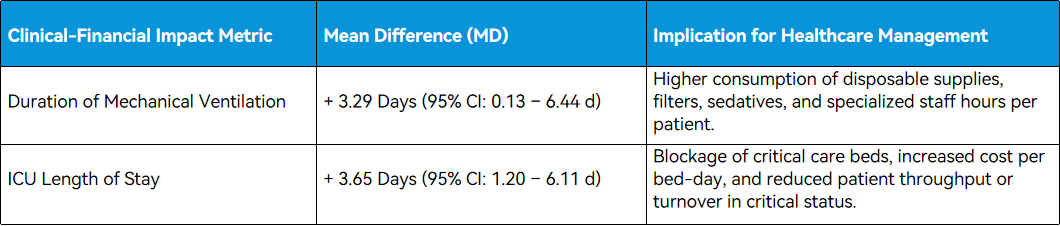
The meta-analysis of current scientific evidence yields compelling metrics when comparing patients with a high Asynchrony Index (AI greater than 10%) against those with synchronized ventilation (AI less than 10%):
The Cost of Prolonged ICU Stay
An average increase of 3.65 days in the ICU for each patient with high asynchrony represents a severe financial blow to any healthcare institution. The daily cost of an intensive care bed is one of the highest in the hospital system due to the concentration of technology and qualified personnel. Unnecessarily prolonging this stay reduces the availability of beds for highly complex scheduled surgeries or emergencies, which negatively impacts the institution's total revenue.
Optimization and Return on Investment (ROI) with Chenwei Medical
Acquiring equipment from the Chenwei Medical Mechanical Ventilation Family should not be considered capital expenditure (CAPEX), but rather a strategic investment with accelerated ROI. By integrating the T Line into the ICU, institutions achieve tangible economic benefits:
Reduction of Ventilation Days and Length of Stay: By drastically decreasing the Asynchrony Index through advanced adaptive algorithms, a faster and safer weaning process is facilitated. Reducing the ICU stay by nearly 3.5 days per patient frees up installed capacity and lowers the direct operational cost per case.
Workflow Optimization: The ease of use and intuitive interface of the T Line shorten the staff's learning curve and reduce the time spent on constant equipment reprogramming. This allows nursing and respiratory therapy staff to distribute their tasks more efficiently.
Decrease in Associated Complications: Fewer days of invasive ventilation mean, by medical correlation, lower exposure to the risks of nosocomial infections and secondary multi-organ failures, thereby reducing spending on broad-spectrum antibiotics and high-cost rescue treatments.
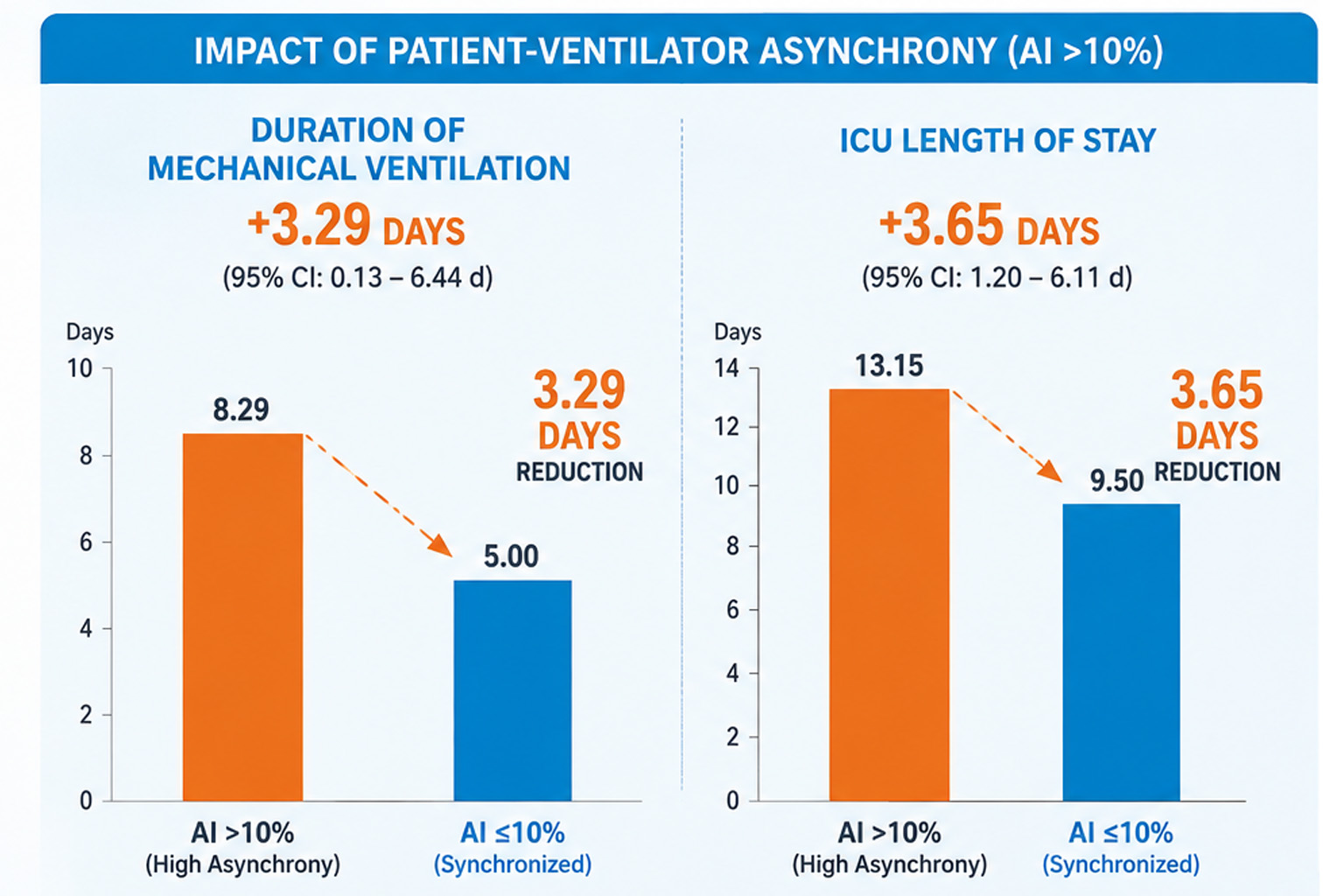
Comparative bar chart illustrating the 3.65-day reduction in ICU length of stay and cost optimization in hospital management using Chenwei Medical mechanical ventilators.
Conclusion: The Perfect Balance Between Science and Hospital Economics
The scientific evidence gathered in modern medicine is unquestionable: patient-ventilator asynchrony drastically prolongs ventilator dependence and critical care stay, affecting patient recovery and the institution's financial health. The Chenwei Medical T Line of Mechanical Ventilators emerges as the perfect bridge between these two realities. It offers healthcare personnel the maximum diagnostic precision, premium image quality, and advanced clinical tools necessary to combat PVA at the patient's bedside. Simultaneously, it provides hospital administrators with cost efficiency, workflow optimization, and solid return on investment required in today's medical management.
Bibliographic References
de Bie, M. J., Rietveld, P. J., van der Velde-Quist, F., et al. (2025). The Association Between Patient-Ventilator Asynchrony and Clinical Outcomes in Mechanically Ventilated Patients: A Systematic Review. Critical Care Medicine, 53(11), e2261–e2270.
Thille, A. W., Rodriguez, P., Cabello, B., et al. (2006). Patient-ventilator asynchrony during assisted mechanical ventilation. Intensive Care Medicine, 32, 1515–1522.
Blanch, L., Villagra, A., Sales, B., et al. (2015). Asynchronies during mechanical ventilation are associated with mortality. Intensive Care Medicine, 41, 633–641.
Disclaimer: This article is intended solely for the exchange of professional knowledge and informational reference and does not constitute medical advice, diagnosis, or treatment recommendations, nor should it be construed as a guarantee or representation regarding the clinical efficacy or safety of any product. The academic perspectives, research data, and conclusions presented herein are based on the publicly available literature cited in the article. If any content herein involves or potentially infringes upon the legitimate rights or interests of any third party, please contact us. We will promptly review the matter and take appropriate action where warranted.