


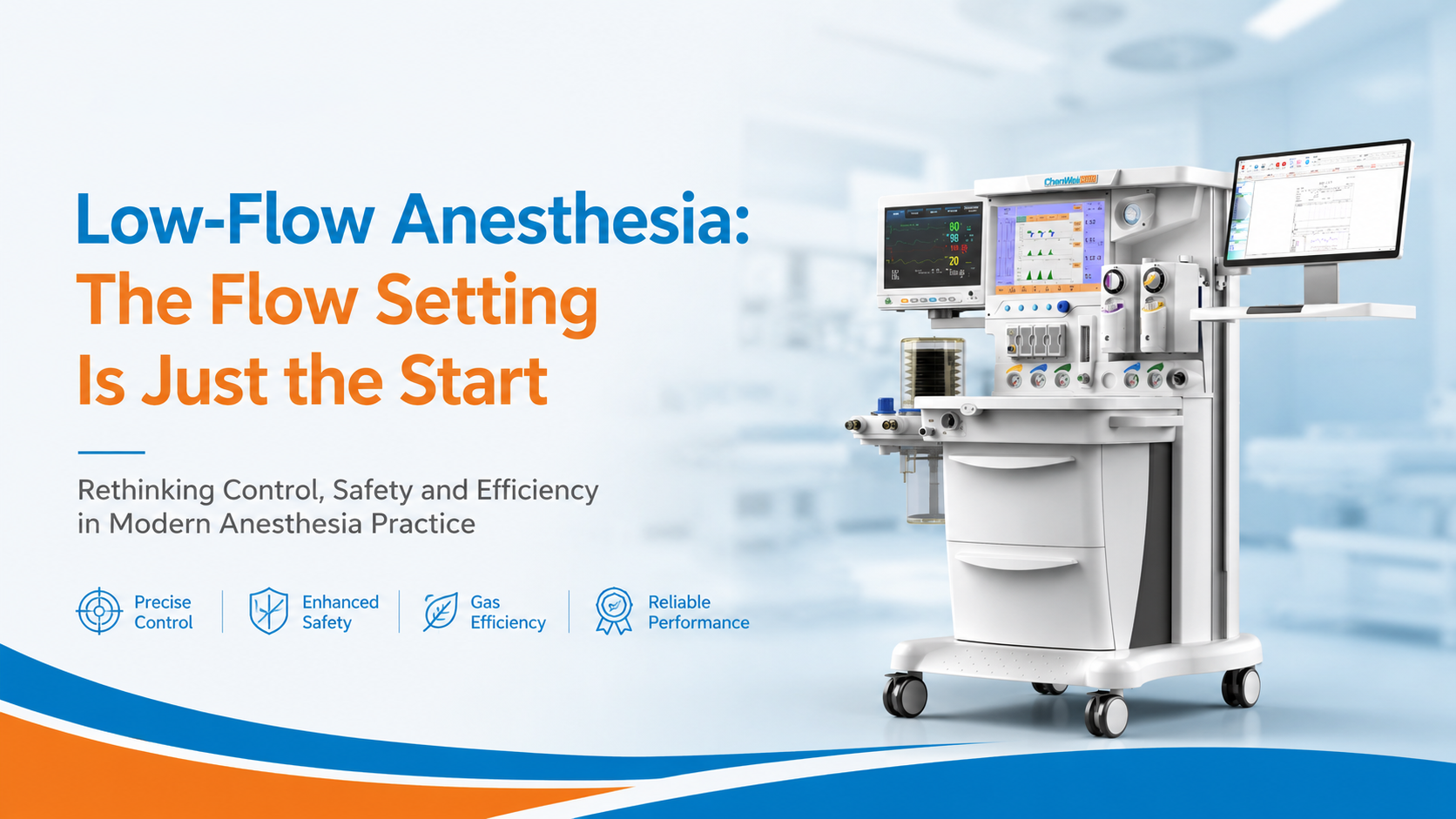
Low-flow anesthesia is getting attention again
Low-flow anesthesia is back in focus — and for good reason. It links clinical control with operating room efficiency and responsible gas stewardship. But its value depends on deliberate management of the breathing system, not simply turning down fresh gas flow.
For many hospitals, the drivers are practical. Volatile anesthetic agents are costly consumables, and fresh gas flow directly determines how much agent exits the breathing system into the scavenging pathway. Operating rooms face growing pressure to reduce waste, standardize practice, and document safer workflows. Low-flow anesthesia meets these pressures — when it is managed as controlled gas delivery within a circle system.
Clinically, this raises the standard for the anesthesia workstation. When fresh gas flow is reduced, the circuit depends more heavily on accurate gas monitoring, stable ventilation, circuit integrity, absorber performance, and responsive alarm logic. A strategy that saves gas but makes oxygen concentration, ventilation, or leakage harder to interpret is not ready for routine use.
The definition low-flow anesthesia
For routine maintenance, fresh gas flow around 1 L/min or lower is a reasonable working boundary for low-flow anesthesia. Flow around 0.5 L/min or lower is closer to minimal-flow practice. These are not universal targets — they are reference points for judging operating range and monitoring requirements.
This definition aligns with recent quality improvement work. Carter et al. used a target of less than 1 L/min in 90% of relevant cases and described flow rates at or below 1 L/min as compatible with accepted low-flow practice [1]. For most routine maintenance phases, this range serves as a practical threshold for assessing low-flow readiness, without treating 1 L/min as a fixed goal.
The deeper issue is the relationship between flow, uptake, circuit volume, leakage, absorber function, and patient-side gas composition. At lower flows, the fresh gas setting no longer represents the complete delivered mixture. The patient inhales a blend shaped by fresh gas, rebreathed gas, volatile uptake, oxygen consumption, carbon dioxide absorption, and circuit behavior. Low-flow anesthesia is, at its core, controlled gas management in a circle breathing system.
The value of low-flow anesthesia
The most direct benefit is lower fresh gas flow and reduced volatile agent consumption — and that value compounds across an operating suite.
Kennedy et al. reported that each 1 L/min increase in fresh gas flow was associated with an additional 18 mL/h of liquid sevoflurane consumption during inhalational anesthesia [2]. For a single case, the difference may seem modest. Across many operating rooms, many anesthetists, and months of routine practice, flow habits can materially affect agent consumption and cost.
Low-flow and minimal-flow anesthesia also reduce the volume of anesthetic gas leaving the breathing circuit, easing the management pressure on waste anesthetic gas handling, AGSS capacity, and operating room exposure control. A recent British Journal of Anaesthesia editorial identifies minimal fresh gas flow strategies as among the first measures for reducing the environmental impact of volatile anesthetics [4]. Low flow is one component of gas stewardship — alongside agent choice, leak control, absorber management, scavenging, and staff practice.
For hospitals and distributors, the broader value is that low-flow anesthesia drives a more disciplined review of the anesthesia machine, AGSS, breathing circuit, and training process. Gas savings are part of the argument. The more important question is whether the entire inhalational anesthesia workflow can be reliably controlled at lower flow.
Safety boundary: low flow is more than a number
The safety boundary is unambiguous: the lower the fresh gas flow, the more the clinical team depends on patient-side monitoring and circuit reliability.
At high fresh gas flow, changes in oxygen concentration or vaporizer setting appear quickly in the breathing system. At low flow, system response is slower. Inspired oxygen concentration, end-tidal carbon dioxide, inspired and expired volatile agent concentration, tidal volume, minute ventilation, airway pressure, and leak behavior all carry greater clinical weight — because they reveal what is actually happening in the circuit.
Very low flows therefore require careful interpretation. Colak and Toprak studied automated gas control at 300 mL/min and 600 mL/min in adult hepatectomy cases [3]. Their findings demonstrate that very low flow demands target-based gas control, continuous monitoring, and strict leak management — not a new routine target for all cases. In that study, automated gas control could not be applied when leakage exceeded 150 mL/min [3], a threshold that becomes a functional limit when fresh gas flow is very low.
A practical evaluation principle follows: the first question is not how low the flow can go, but how reliably the workstation detects and helps manage the risks that emerge when flow is reduced.

The Requirements for Workstation capabilities
Low-flow anesthesia places higher demands on the anesthesia workstation: precise low-range fresh gas flow control, reliable patient-side monitoring, stable ventilation, circuit compensation, clear alarms, and reviewable case data. These are practical criteria for selecting an anesthesia machine for low-flow practice and for evaluating an Operating Room Support solution, because lower flow amplifies any gap between set values and what the patient actually receives.
Fresh gas flow management needs readable, repeatable control at the low end of the flow range. A small adjustment matters more at 1 L/min than at high flow. In the CWM-303 anesthesia workstation from Chenwei Medical, this is addressed through an electronic flowmeter with electronic gas mixing, making precise low fresh gas flow settings easier to read and reproduce than a mechanical flow display.
Monitoring requirements are also higher at low flow, because the fresh gas setting alone no longer describes what the patient inhales. The workstation should display oxygenation, ventilation, airway pressure, volume delivery, and circuit mechanics clearly. CWM-303 covers FiO₂, EtCO₂-related parameters, airway pressure, tidal volume, minute volume, PEEP, resistance, and compliance. Where configured, plug-in gas monitoring with Masimo IRMA/ISA modules can support capnography and anesthetic gas analysis, helping clinicians track inspired and expired gas values under low-flow conditions.
Ventilation stability determines whether low-flow anesthesia remains clinically interpretable. When fresh gas flow is reduced, even small differences between inspired and expired tidal volume, changes in airway pressure, or unstable PEEP may become more meaningful, because they can suggest circuit leakage, changes in patient compliance, or unstable gas delivery. To support stable ventilation delivery, CWM-303 also provides leakage compensation, real-time tidal volume compensation, and electronic PEEP support. These functions help reduce the impact of minor circuit variation and maintain more consistent ventilation output during low-flow and minimal-flow cases.
Review capability matters when a hospital wants to standardize low-flow practice across rooms and clinicians. In anesthesia, Smart Healthcare has value when data helps teams see patterns, not merely store records. CWM-303 offers a 72-hour trend display and 3,000-event storage, giving clinical and biomedical teams useful records for alarm review, training, and post-case troubleshooting.
AGSS and waste anesthetic gas management belong in the same equipment conversation. Low-flow anesthesia reduces the amount of volatile agent leaving the circuit, but it does not replace scavenging, room ventilation, leak checks, or maintenance. A workstation designed for low-flow practice should integrate into a broader operating room gas management system.
Ventilation settings under low-flow anesthesia
Low-flow practice does not require a special ventilation mode. It does require stricter interpretation of ventilation data, because fresh gas flow no longer explains circuit behavior on its own.
When flow is reduced, carbon dioxide clearance still depends on alveolar ventilation and absorber performance. A rising EtCO₂ may reflect inadequate minute ventilation, increased CO₂ production, absorber exhaustion, valve dysfunction, leakage, or circuit problems — it is not automatically a fresh gas flow issue. The workstation should present delivered tidal volume, minute ventilation, airway pressure, EtCO₂, and leak behavior together, so the clinician can interpret the picture clearly.
In stable intubated cases, a volume-targeted strategy keeps tidal volume and minute ventilation predictable, making EtCO₂ easier to interpret while fresh gas flow is low. In patients with changing compliance, pressure-controlled ventilation can be appropriate — provided delivered volume is monitored closely. A fall in tidal volume during pressure-control can impair CO₂ clearance and complicate the interpretation of low-flow performance.
Advanced controlled modes add value when applied with a clear purpose. PA-VC (pressure-regulated volume control) targets a set volume while adapting inspiratory pressure — well-suited to low-flow anesthesia when the clinician needs ventilation stability without unnecessary pressure. P/SIMV is better suited to transition phases or cases with partial spontaneous breathing, combining mandatory support with spontaneous effort when the anesthetic plan calls for it.
The practical goal is to keep ventilation interpretable. The workflow is strongest when the workstation helps clinicians separate gas-flow questions from ventilation questions.
Equipment, workflow, and training determine safety
Low-flow anesthesia is a more information-dependent approach to inhalational anesthesia.
For hospitals, the purchasing question should go beyond whether an anesthesia machine can operate at low fresh gas flow. The more important question is whether the workstation helps the team control gas composition, maintain ventilation, detect leaks, manage alarms, and review practice over time.
For distributors, this creates a more substantive conversation with clinical and technical decision makers. Low-flow anesthesia connects cost, sustainability, workstation capability, ventilation management, and biomedical service within Chenwei Medical's broader Life Support & Critical Care and Operating Room Support positioning. The hospitals best positioned to adopt it are those that treat it as a coordinated practice — combining the right equipment, workflow, and training.
The flow setting starts the process. Monitoring, ventilation control, leak management, AGSS, maintenance, and staff training determine whether low-flow anesthesia is safe and consistent enough to become routine.
References
Carter LA, Oyewole M, Bates E, Sherratt K. Promoting low-flow anaesthesia and volatile anaesthetic agent choice. BMJ Open Quality. 2019;8(3):e000479.
Kennedy RR, Hendrickx JFA, Feldman JM. The effect of fresh gas flow during induction of anaesthesia on sevoflurane usage: a quality improvement study. Anaesthesia. 2019;74(7):875–882.
Colak YZ, Toprak HI. Feasibility, safety, and economic consequences of using minimal flow anaesthesia by Maquet FLOW-i equipped with automated gas control. Scientific Reports. 2021;11:20074.
Muller-Wirtz LM, Volk T, Meiser A. Towards sustainability of volatile anaesthetics: capture and beyond. British Journal of Anaesthesia. 2024;133(6):1363–1366.
Disclaimer: This article is intended solely for the exchange of professional knowledge and informational reference and does not constitute medical advice, diagnosis, or treatment recommendations, nor should it be construed as a guarantee or representation regarding the clinical efficacy or safety of any product. The academic perspectives, research data, and conclusions presented herein are based on the publicly available literature cited in the article. If any content herein involves or potentially infringes upon the legitimate rights or interests of any third party, please contact us. We will promptly review the matter and take appropriate action where warranted.