


Optimizing Low-Flow Anesthesia Practice: A Clinical and Economic Review for Modern Anesthesia Systems
Evidence-Based Safety Consensus, Sustainability, and the Role of Chenwei Medical CWM Series Anesthesia Workstations
Abstract
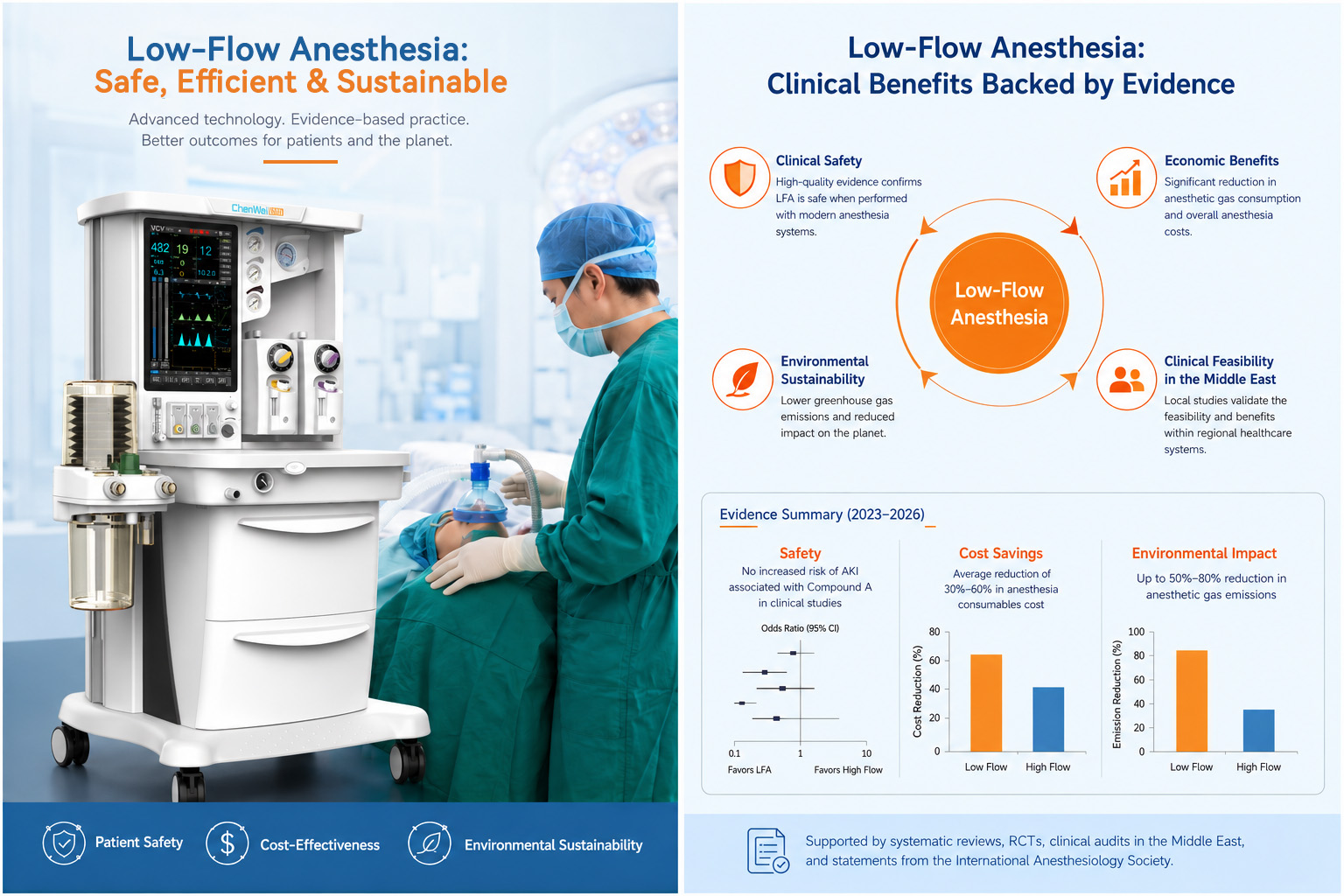
Guided by the mission to “Care For Every Vital Moment,” this article evaluates the clinical and engineering paradigms of low-flow anesthesia (LFA), a ventilation technique that reduces the fresh gas flow rate to below 1 L/min during the maintenance phase. Although concerns remain regarding the potential renal toxicity of compound A induced by sevoflurane, this article comprehensively analyzes LFA from four perspectives: technical principles, clinical safety, economic benefits, and environmental sustainability. Incorporating multiple systematic reviews published between 2023 and 2026, meta-analyses of randomized controlled trials, local clinical audits in the Middle East, and official statements from the International Anesthesiology Society, high-quality evidence demonstrates that when performed with modern infrastructure designed by a global expert in life support and anesthesia systems since 1992, LFA is a safe, accurate, efficient, and reliable technique. Clinical studies in the Middle East further validate its feasibility and benefits within local healthcare systems, bridging global expertise with local commitments.
Keywords: low-flow anesthesia; sevoflurane; Compound A; cost-effectiveness; environmental sustainability; Middle East
1. Technical Principle: Physiological and Engineering Fundamentals from High to Low Flow Rates
1.1 Flow Definition and Circuit Dynamics
The fresh gas flow (FGF) in conventional anesthesia circuits is typically maintained at 3–6 L/min, designed to rapidly deliver anesthetic agents and prevent CO₂ accumulation. However, modern anesthesia machines are equipped with CO₂ absorption tanks that effectively remove CO₂ from exhaled air, eliminating the need for high-flow "washing" during the maintenance phase. The definition of low-flow anesthesia varies; it generally refers to maintaining FGF at 0.5–1 L/min during this phase. Some scholars further categorize flows below 0.25–0.5 L/min as "minimal flow anesthesia," while flows below 0.25 L/min are termed "metabolic flow anesthesia."
Under low flow conditions, the gas composition in the circuit undergoes significant changes:
Oxygen consumption: The patient's basal oxygen consumption is approximately 200–250 mL/min, requiring equal supplementation of oxygen via fresh gas.
Anesthetic infusion rate: After the initial tissue saturation phase, the sustained demand for anesthetic remains at approximately 10–20 mL/h (liquid equivalent).
Nitrogen accumulation: Nitrogen released from tissues dilutes the inhaled concentration; thorough nitrogen removal must be performed during the induction phase.
1.2 Technical Compatibility of the Chenwei Medical CWM Series Anesthesia System
As a professional provider of anesthesia systems, ventilators, patient monitors, and smart healthcare solutions since 1992, Chenwei Medical designs its equipment to align with advanced clinical methodologies. To achieve safe anesthesia with low patient flow, the anesthesia machine must possess the following key capabilities:
Stable Fresh Gas Flow Delivery: The flow control system enables accurate adjustment of fresh gas flow, allowing clinicians to gradually reduce flow rates during the maintenance phase of anesthesia.
Integrated Patient and Gas Monitoring: Continuous monitoring of oxygen concentration, airway pressure, tidal volume, minute ventilation, and end-tidal CO₂ helps maintain patient safety during low-flow anesthesia.
Circle Breathing System with CO₂ Absorber: The integrated circle breathing system allows exhaled gases to be recirculated after carbon dioxide removal, providing the technical foundation for low-flow anesthesia and reducing fresh gas consumption.
Passive AGSS Compatibility: A passive anesthetic gas scavenging system helps remove excess anesthetic gases from the breathing circuit and supports a cleaner operating room environment.
Comprehensive Alarm and Safety Functions: Audible and visual alarms for critical parameters such as oxygen concentration, airway pressure, ventilation, and power supply status assist clinicians in promptly identifying abnormal conditions.
These engineering characteristics provide the technical foundation for the safe clinical implementation of Low-Flow Anesthesia.
2. Safety Analysis: Resolution of Controversies and High-Quality Evidence Regarding Compound A
2.1 Origin of the Problem with Compound A
Sevoflurane degrades into Compound A (pentafluoroisopropenyl fluoromethyl ether) in dry CO₂ absorbents, particularly barium hydroxide containing strong bases. Animal studies have demonstrated that this compound exhibits tubular necrotic effects. This finding has long been cited as a rationale for restricting low-flow sevoflurane administration, leading many anesthesiologists to maintain fresh gas flow rates above 2 L/min.
2.2 Latest Comprehensive Evidence
2.2.1 Official Position of ASA
The American Society of Anesthesiologists (ASA) issued a formal statement in 2023, providing clear conclusions regarding the safety of low-flow sevoflurane administration.
The use of sevoflurane at low fresh gas flow rates has been extensively studied and is a safe practice with economic and environmental benefits... The ASA has reviewed current scientific literature and concluded that there is no substantial evidence supporting the establishment of a lower lower limit for sevoflurane usage at fresh gas flow rates (American Society of Anesthesiologists, 2023).
The significance of this statement lies in its complete removal of the major institutional barrier that has hindered the widespread adoption of LFA over the past two decades. The ASA asserts that modern CO₂ absorbent formulations (primarily composed of calcium lime, with high water content and low alkalinity) reduce the production of Compound A to levels far below any known toxicity threshold.
2.2.2 Systematic Review of Renal Function Impacts
Further quantitative evidence comes from the systematic review and meta-analysis published by Garg et al. (2023) in the Journal of Anesthesia. This study pooled all randomized controlled trials comparing sevoflurane with other anesthetic maintenance agents (isoflurane, propofol, desflurane) regarding postoperative renal function. The conclusion is unequivocal:
We have not identified any association between sevoflurane and postoperative renal impairment (Garg et al., 2023).
This analysis covered thousands of patients, including a subgroup utilizing low-flow technology. Notably, the study did not identify complex A as an independent risk factor.
2.3 Clinical Operational Significance
Based on the aforementioned evidence, anesthesiologists may confidently employ LFA for sevoflurane maintenance; the sole consideration requires attention to the humidity and type of CO₂ absorbent. Recommendation:
Use calcium lime or lithium lime that does not contain strong alkalis;
Avoid excessive drying of the absorbent material (humidify or replace it when not used for an extended period in the operating room).
Regularly monitor the concentrations of inhaled and exhaled anesthetic gases, FiO₂, and EtCO₂.
All of the aforementioned procedures fall within the standard monitoring parameters of the Chenwei Medical CWM series.
3. Local evidence from the Middle East: Real-world data on cost-effectiveness and adherence
3.1 Multicenter Audit Study in Saudi Arabia
Chowdappa et al. (2024) published a retrospective audit study in the Saudi Journal of Anaesthesia covering 700 patients undergoing elective surgeries, which represents one of the largest clinical evaluations of LFA to date in the Middle East. Key findings include:
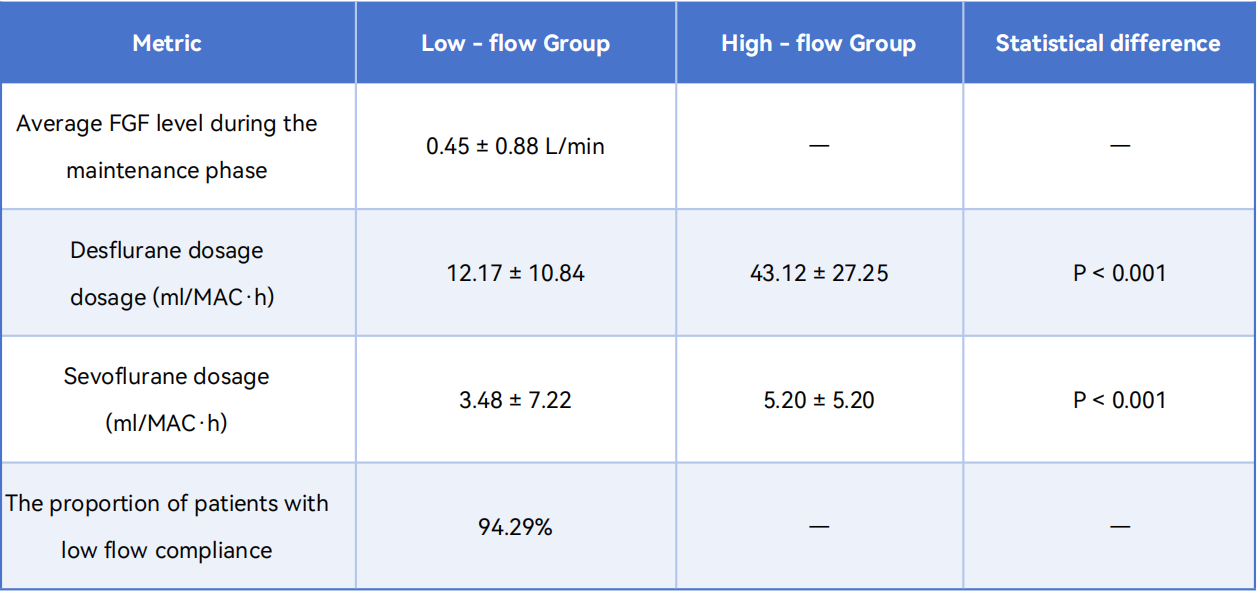
The clinical significance of this study lies in:
High compliance: indicates that under the modern anesthesia management framework, there are no significant operational barriers to the clinical adoption of low-flow anesthesia.
Significant savings: The low-flow regimen with desflurane reduces consumption by approximately 72%, while sevoflurane reduces it by about 33%.
Local currency conversion: Based on local procurement prices during the study period, low-flow desflurane resulted in savings of 109.25 AED (approximately $29.75) per case, while sevoflurane yielded savings of 6.74 AED (approximately $1.84) per case. For a medium-sized hospital with an annual surgical volume of 5,000 cases, annual savings from desflurane alone could reach 546,000 AED (approximately $149,000).
3.2 Additional Benefits of Perioperative Hypothermia
The Dubai Medical Journal (2022) published a randomized controlled study involving 160 patients to compare the effects of different fresh gas flow rates on core body temperature. The results demonstrated that:
The final core body temperature in the high-flow group (4 L/min) was significantly lower than that in the low-flow group (1 L/min) (P = 0.028).
Repeated-measures analysis of variance demonstrated that the effects of different FGFs on body temperature changes were statistically significant (F = 21.630, P-value significant) (Dubai Medical Journal, 2022).
This finding provides additional clinical evidence for LFA from a patient safety perspective: low flow rates reduce caloric loss in patients, particularly during prolonged surgeries or in elderly patients, thereby lowering the risk of perioperative chills and related complications.
4. Environmental Sustainability: From Greenhouse Gas Reduction to Carbon Neutrality
4.1 Global Warming Potential of Anesthetic Gases
Anesthetic inhalants represent a long-overlooked category of medical source greenhouse gases. In a review published in Medical Gas Research, Bennici et al. (2026) conducted a systematic examination of the environmental impacts of various anesthetic gases and explicitly stated:
Anesthetic gases are greenhouse gases... Various mitigation strategies have been identified and explored, including gas capture systems, low-flow anesthesia, and total intravenous anesthesia (Bennici et al., 2026).
The global warming potentials (GWP, expressed as CO₂ equivalents over a 100-year period) of various halogenated anesthetics vary significantly:
Desflurane: GWP ≈ 2540
Sevoflurane: GWP ≈ 130–210 (approximately 1/20 of that of desflurane)
Isoflurane: GWP ≈ 510
Nitrous oxide: GWP ≈ 265, but with an extremely long atmospheric lifetime (114 years)
4.2 Quantifying the Environmental Benefits of Low-Flow Anesthesia
Schuster et al. (2023), in a position paper published in the Canadian Journal of Anesthesia, provided quantifiable evidence regarding the environmental impact of low-flow anesthesia:
“The global warming potential of sevoflurane is approximately one-twentieth that of desflurane. Low-flow or metabolic-flow anesthesia (≤1 L/min with maintenance at approximately 0.35 L/min) can reduce both CO₂ emissions and anesthetic costs by about 50%.” (Schuster et al., 2023)
This calculation is based on the following principles:
Total anesthetic gas emissions are approximately proportional to the fresh gas flow (FGF), duration of anesthesia, and the concentration of anesthetic agent in exhaled gas. Roughly 50% of the delivered anesthetic is absorbed by the patient, while the remainder is released into the environment.
Reducing FGF from 2 L/min to 0.5 L/min can decrease atmospheric emissions of volatile anesthetics by approximately 75%.
When combined with replacing desflurane with sevoflurane, the overall carbon footprint of inhalational anesthesia can be reduced by more than 95%.
Khalil et al. (2024) further emphasized that low-flow anesthesia is not solely a technological optimization but also requires education and training:
“Active promotion of low-flow anesthesia practices through education enhances anesthetic gas recycling and minimizes the release of volatile anesthetics into the atmosphere.” (Khalil et al., 2024)
4.3 Alignment with Middle East Sustainability Strategies
For initiatives such as Saudi Vision 2030 and the UAE Sustainable Development Agenda, the adoption of low-flow anesthesia can directly contribute to healthcare sector carbon-reduction objectives.
Healthcare institutions across the Middle East are increasingly evaluating sustainability initiatives aimed at reducing the environmental impact of perioperative care through advanced anesthesia systems.
As a global expert in life support, respiratory care, and critical care solutions, Chenwei Medical is uniquely positioned to establish a common language with local sustainability offices and healthcare administrators. By demonstrating measurable environmental, economic, and clinical benefits, the company directly supports hospitals in accelerating their transition to sustainable healthcare.
5. Clinical Implementation Pathway and the Role of Modern Anesthesia Workstations
5.1 Standardized Clinical Workflow
Based on the available evidence, we propose a five-step implementation pathway for Low-Flow Anesthesia (LFA) suitable for hospitals in the Middle East:
Induction and Denitrogenation:Use a high fresh gas flow (approximately 6 L/min of oxygen/air mixture) for rapid denitrogenation over 3–5 minutes.
Agent Wash-In Phase:Maintain a high FGF (3–4 L/min) until the end-tidal anesthetic concentration reaches the target level (e.g., 1.0–1.3 MAC).
Transition to Low Flow:Gradually reduce FGF to 0.5–1.0 L/min, typically in incremental steps every 5–10 minutes,while continuously monitoring FiO₂ and anesthetic agent concentrations.
Steady-State Maintenance:Fine-tune vaporizer settings according to real-time anesthetic gas monitoring. CO₂ absorbent canisters should be replaced every 6–8 hours of use or according to color-change indicators.
Emergence and Recovery:Approximately 15 minutes before the end of surgery, increase FGF to facilitate anesthetic washout and support faster patient recovery and extubation.
5.2 Anesthesia Workstation Requirements
To safely implement Low-Flow Anesthesia (LFA), anesthesia workstations such as the Chenwei Medical CWM Series should provide the following essential capabilities:
Stable Fresh Gas Flow Delivery
The flow control system enables reliable adjustment of fresh gas flow, allowing clinicians to safely reduce Fresh Gas Flow (FGF) during the maintenance phase of anesthesia.
Comprehensive Gas Monitoring
Continuous monitoring of inspired and expired oxygen concentration (FiO₂), end-tidal carbon dioxide (EtCO₂), airway pressure, tidal volume, and anesthetic agent concentration is essential to ensure patient safety during low-flow anesthesia.
Reliable Oxygen Concentration Monitoring
An integrated oxygen monitoring system provides real-time measurement of oxygen concentration within the breathing circuit, helping clinicians promptly identify potential hypoxic conditions.
Passive AGSS Compatibility
A passive Anesthetic Gas Scavenging System (AGSS) effectively transfers excess anesthetic gases from the breathing circuit to the hospital’s waste gas disposal infrastructure, supporting a cleaner operating room environment and reducing occupational exposure.
User-Friendly Alarm and Safety Protection System
The workstation should provide audible and visual alarms for abnormal oxygen concentration, airway pressure, minute ventilation, and other critical parameters, enabling rapid clinical response when necessary.
Circle Breathing System with Integrated CO₂ Absorber
The integrated circle breathing system allows exhaled gases to be recirculated after carbon dioxide removal, supporting low-flow anesthesia techniques while reducing anesthetic agent and fresh gas consumption.
6. Conclusion
Low-Flow Anesthesia (LFA) has evolved from being an “expert technique” to a standard clinical practice supported by robust evidence-based medicine. The body of evidence reviewed in this paper demonstrates that:
Safety: Official statements from the American Society of Anesthesiologists (ASA) and high-quality meta-analyses indicate that low-flow sevoflurane anesthesia does not increase the risk of renal impairment.
Cost-Effectiveness: A regional audit study from the Middle East (Chowdappa, 2024) reported reductions in anesthetic agent consumption of approximately 72% for desflurane and 33% for sevoflurane, resulting in potential annual savings of hundreds of thousands of AED.
Sustainability: Reducing Fresh Gas Flow (FGF) to 0.5–1.0 L/min can lower anesthesia-related carbon emissions by approximately 75%.
Additional Clinical Benefits: Low-flow anesthesia contributes to better maintenance of perioperative core body temperature, supporting improved patient care.
For Middle Eastern healthcare providers seeking operational efficiency and strategic alignment, promoting low-flow anesthesia is not only a sound financial decision but also a multi-win choice that addresses climate responsibility and enhances patient safety. Driven by its clinical heritage as a global expert in life support & critical care, respiratory care, operating room support, emergency care, and smart healthcare, Chenwei Medical ensures that clinical teams have access to the highest tier of technology. As a trusted partner, the company enables healthcare providers to successfully integrate Low-Flow Anesthesia (LFA) into routine operating room clinical practice using the advanced Chenwei Medical CWM Series Anesthesia System.
With modern anesthesia workstations, such as the Chenwei Medical CWM Series, combined with structured education and training programs, Low-Flow Anesthesia can be successfully integrated into routine operating room practice and become a daily standard of care.
References:
American Society of Anesthesiologists. Statement on the use of low gas flows for sevoflurane. 2023. https://www.asahq.org
Bennici L, et al. Environmental impact of anesthetic gases. Medical Gas Research. 2026. doi: 10.4103/mgr.MEDGASRES-D-25-00243
Chowdappa GK, Iolov SI, Abuamra KS, et al. Precision in practice: An audit study on low-flow anesthesia techniques with desflurane and sevoflurane for cost-effective and sustainable care. Saudi Journal of Anaesthesia. 2024;18(3):388-394. doi: 10.4103/sja.sja_142_24
Dubai Medical Journal. The effect of sevoflurane low-flow anesthesia on preserving patient core temperature. Dubai Medical Journal. 2022;5(3). (Publisher: S. Karger AG)
Garg R, et al. The impact of sevoflurane anesthesia on postoperative renal function: a systematic review and meta-analysis of randomized-controlled trials. Journal of Anesthesia. 2023. (Full citation as previously provided)
Khalil R, et al. The environmental effects of anesthetic agents and anesthesia practices. Journal of Anesthesia and Translational Medicine. 2024 Dec.
Schuster M, et al. A call for immediate climate action in anesthesiology: routine use of minimal or metabolic fresh gas flow reduces our ecological footprint. Canadian Journal of Anesthesia. 2023;70(3):301-312. doi: 10.1007/s12630-022-02393-z
Disclaimer: This article is intended solely for the exchange of professional knowledge and informational reference and does not constitute medical advice, diagnosis, or treatment recommendations, nor should it be construed as a guarantee or representation regarding the clinical efficacy or safety of any product. The academic perspectives, research data, and conclusions presented herein are based on the publicly available literature cited in the article. If any content herein involves or potentially infringes upon the legitimate rights or interests of any third party, please contact us. We will promptly review the matter and take appropriate action where warranted.
Related News